
Field Notes
I Played Two Games With the Same Generosity. Only One Kept Me.
Rogue Legend and Dicero, played side by side, near-identical free currency economies on paper. I dropped one within a month. I'm still opening the other every day, four months later. The difference was never how generous either game was. It was where.
I played Rogue Legend and Dicero side by side this year, at the same time, on purpose. Both hooked me hard in the first week. I dropped Dicero first. I'm still opening Rogue Legend every single day, four months later.
On paper, they should feel the same. Both hand out free keys and chest openings at roughly the same rate. If you only looked at that one number, you'd call them equally generous. You'd be wrong.
Why gear progression carries so much weight
There's one thing that matters more than anything else in a rogue-lite: can the player see themselves getting stronger? Gear progression is the best tool either game has for that, because it's visual. You don't read a number or dig through a menu, you look at the color of what you're wearing. Grey to green to blue to purple to gold, and you feel the climb just by glancing at your own character. That's a big part of what drives player motivation in this genre specifically.
It's not a minor system sitting next to the "real" progression. In a rogue-lite, it basically is the progression players notice most. And it's not something you feel run by run. It's a sense that builds up over dozens of sessions, an overall feeling of whether you're actually getting anywhere. That's exactly why it's so hard to pin to one data point.
Three of a kind versus four
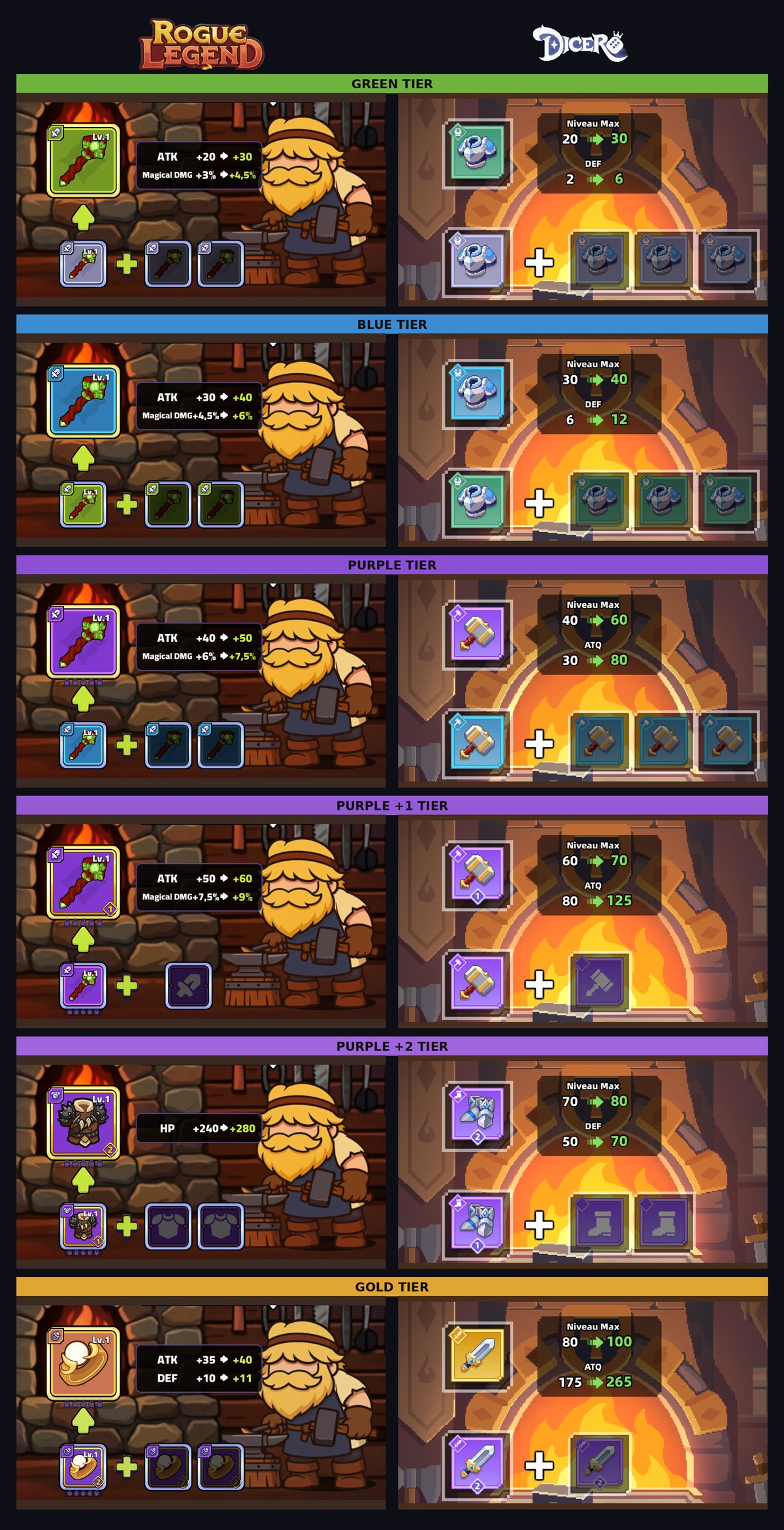
Here's where the two games actually differ. Rogue Legend needs three of the same item to merge up a tier: three grey for one green, three green for one blue, three blue for one purple. Dicero needs four, at every one of those same steps.
At the very top of the ladder, Dicero actually needs fewer high tier merges to reach gold, two against Rogue Legend's three. On paper, that looks like Dicero pulling ahead. It's a mirage. Follow the chain down to the base tier and it flips. Reaching one gold item costs 324 grey-equivalent pieces in Rogue Legend. In Dicero, it costs 512, even with that shorter final stretch. Every high tier piece already paid the steeper four to one ratio, at every step underneath it. That hits faster than the one step it saves you at the top. The bottom of the ladder doesn't just hurt early retention, it compounds all the way to gold.
Problem is almost nobody feels the top of the ladder anyway. New players, free players, casual players, they live at the bottom, grinding grey into green into blue for as long as they stay. That's where Dicero's extra item per merge hits hardest, and it's exactly where I felt it: progress that should take an evening started taking two or three.
I quit Dicero within a month. I'm still playing Rogue Legend four months later, every day.
Why a data scientist would miss this
Here's the part that matters most. It's not that one of these games is more generous than the other. Averaged across the whole game, they're close to identical. One of them is simply generous in the wrong place.
You won't find this in a standard data pull. Time to level and currency given per day both look fine. That's because they're averages, and averages hide exactly the kind of front-loaded friction that kills a new player's first weeks.
You could go further. Build a Monte Carlo simulation of both merge ladders, the way I did for a gacha banner in an earlier post, and it would show you the real pacing gap in black and white. But even that only gets you the mechanical answer. It tells you the math is different. It doesn't tell you the math is different enough to cost you players, or when a slower climb stops being fine and starts making players quit. Connecting a pacing curve to actual churn is a much harder problem and it's not one a data scientist looking only at their own game's numbers would even think to solve. You'd need to already suspect merge pacing was the variable worth testing, and that suspicion only comes from playing not just your own game, but your competitors' too.
The reliable way to close that gap is to A/B test it directly. Take two or three candidate merge formulas, three of a kind against four of a kind, or whatever range you're actually weighing. Ship each variant to a different cohort of new players. Use an early access period, or a staged rollout to a couple of smaller markets before the big launch. Then track day one, day seven, and day thirty retention against each formula, not just time to complete a tier. That's how you turn "this feels slower" into a number a studio can act on, before a mechanic ships everywhere. It's the only way to know ahead of time which formula is quietly costing you players, before your churn numbers tell you the hard way.
Being generous is what earns you the right to ask for money
Eino Joas' talk on rebuilding Clash of Clans makes a bigger point, and it's worth borrowing here. His team's own rule was that retention always trumps monetization. The logic follows from there. An economy that's too loose means nobody ever needs to pay for anything. But an economy that's too stingy prevents players from moving forward at all. They stall out, they leave, and you lose the chance to monetize them completely. Not because they finished the game for free. Because they never got far enough in to even consider paying you anything.
That's the exact mechanism behind Dicero. Not that free players finish it without spending. Enough of them never get past the early grind to find out if they'd have spent at all. The generosity has to land in the sweet spot between the two. Being generous first is what earns you the right to ask for money at all.
Put that principle next to the merge ratio story above and the actual rule gets bigger than either point alone. Generosity isn't one dial you turn up or down. It has a shape: early versus late, felt over the whole climb rather than any single run. Where you place it decides who stays, and who ever gets far enough to pay. That matters more than how much you hand out in total. It's the same trade-off the wider Monetization pillar works through, one model at a time.
Two games, close to the same currency economy on paper, one four-month habit and one one-month exit. The difference was never how generous either game was. It was where.